Understanding TCP and UDP: Best Usage Scenarios and HTTP's Link to TCP
The internet needs rules
The internet is just a massive pile of wires, routers, and vibes.
When data moves across it, things can go wrong constantly.
Packets can:
Get lost
Arrive late
Arrive twice
Arrive in the wrong order
So the internet uses protocols, which are basically agreements on how data should be sent.
Two of the most important ones are TCP and UDP.
They solve the same problem differently. Very differently.
What are TCP and UDP
Think of them as two delivery styles.
TCP
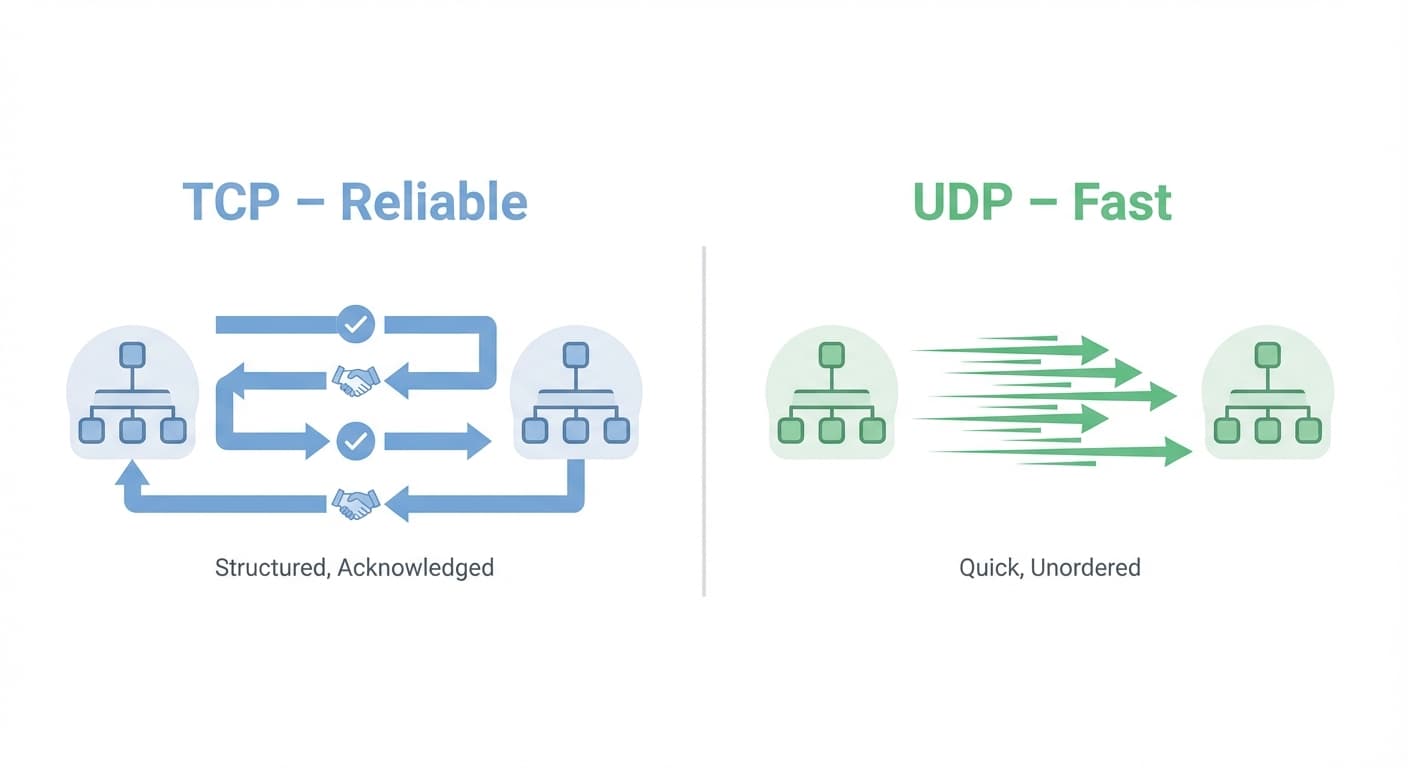
TCP is careful, slow, and responsible.
It checks everything. It waits for confirmation. It resends data if something goes wrong.
It’s like a courier service that makes you sign for the package.
UDP
UDP is fast, reckless, and emotionally unavailable.
It sends data and moves on. No confirmation. No retries.
It’s like shouting information through a megaphone and hoping someone hears it.
Key differences between TCP and UDP
| TCP | UDP |
| Reliable | Unreliable |
| Ordered | Not ordered |
| Slower | Faster |
| Connection-based | Connectionless |
| Error checking + retransmission | No guarantees |

When to use TCP
Use TCP when data accuracy matters more than speed.
Examples:
Website
APIs
Login system
Emails
File uploads and downloads
Payments
If missing or scrambled data would break things or cause panic, TCP is the correct choice.
Basically, anything involving:
Money
Accounts
Persistence
Trust
When to use UDP
Use UDP when speed matters more than perfection.
Examples:
Live video streaming
Online gaming
Voice calls
Live sports broadcasts
DNS queries
If a packet gets lost, it’s usually better to skip it and move forward than wait.
No one wants their Zoom call to freeze just to recover a missed syllable.
Real-world analogy
TCP = Phone call
Both sides connect, talk in order, confirm messages, and hang up properly.UDP = Live announcement
Information is broadcast instantly. If you miss it, tough luck.
Neither is “better”. They’re built for different jobs.
What is HTTP, and where does it fits
Now let’s talk about the protocol that causes the most confusion.
HTTP (Hypertext Transfer Protocol) is an application-level protocol.
Important sentence. Read it again.
HTTP defines:
How requests are structured
How responses look
Methods like GET, POST, PUT, DELETE
Status codes like 200, 404, 500
HTTP does not care how data physically travels.
That’s not its job.

Relationship between TCP and HTTP
Here’s the clean mental model:
HTTP decides what to send
TCP decides how to send it reliably
IP decides where to send it
HTTP runs on top of TCP
TCP handles:
Connection setup
Packet ordering
Retransmissions
Data integrity
HTTP just assumes: “Cool, transport layer has my back.”

Why HTTP does not replace TCP
Because HTTP is not built to:
Detect packet loss
Handle retransmission
Maintain low-level connections
Guarantee order
If HTTP tried to do all that, it would basically reinvent TCP and do a worse job.
Layering exists so protocols don’t step on each other’s responsibilities.

Conclusion
TCP and UDP are transport protocols
TCP = reliable and ordered
UDP = fast and lightweight
HTTP is an application protocol
HTTP relies on TCP to work properly
They solve different problems at different layers
Once this clicks, networking stops feeling like black magic and starts feeling like organised bureaucracy.
Want more?
Blog: https://blogs.kanishk.codes/
Twitter: https://x.com/kanishk_fr/
LinkedIn: https://linkedin.com/in/kanishk-chandna/
Instagram: https://instagram.com/kanishk__fr/