TCP Working: 3-Way Handshake & Reliable Communication
What happens if we send data without rules?
Imagine shouting instructions across a crowded street.
Some words get lost.
Some arrive twice.
Some arrive out of order.
Some arrive when the other person wasn’t even listening yet.
That’s what raw data transfer looks like without rules. Computers are fast, and they need structure.
This is where TCP walks in like the boring but responsible adult.
What is TCP, and why is it needed?
TCP (Transmission Control Protocol) is a communication rulebook used on the Internet to send data reliably.
When you open a website, send a message, upload a file, or log in anywhere, TCP is usually working behind the scenes, making sure:
Data reaches the right place
Nothing important is lost
Everything arrives in the correct order
Both sides agree on what’s happening
Without TCP, the internet would feel like a glitchy group chat with a bad network.
Problems TCP is designed to solve
TCP exists because the Internet itself is unreliable.
It solves the problems like:
Packet loss - data can disappear mid-way
Out-of-order delivery - packets don’t always arrive in sequence
Duplicate packets - sometimes data gets sent twice
Unknown connection state - sender doesn’t know if receiver is ready
TCP doesn’t panic. It plans for all of this.
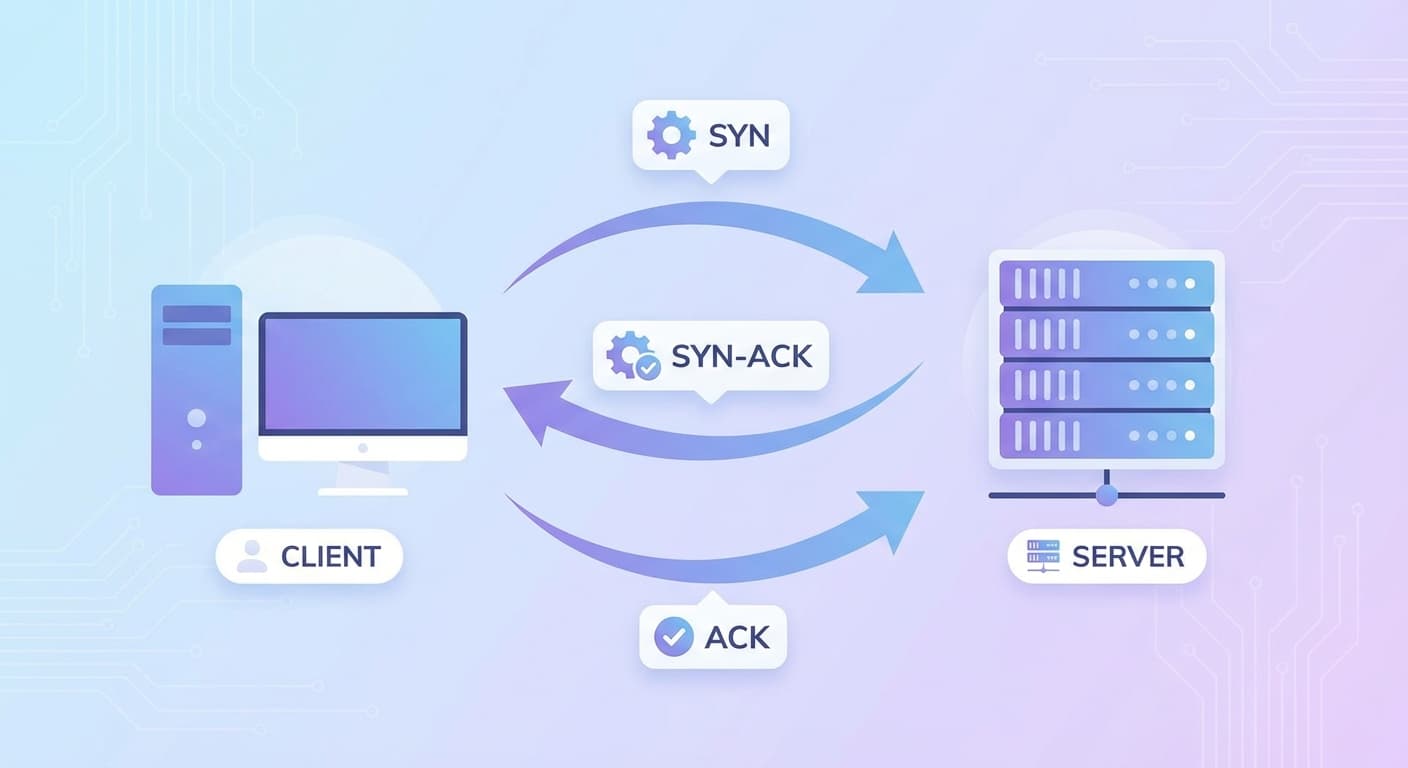
What is the TCP 3-Way Handshake?
Before any real data is sent, TCP makes sure both sides are ready.
This setup process is called the 3-Way Handshake.
Think of it like starting a phone call:
“Can you hear me?”
“Yes, I can hear you. Can you hear me?”
“Yes, we’re connected.”
Only after this does the actual conversation start.
Step-by-step: SYN, SYN-ACK, ACK
SYN (Synchronise)
The client says:
“Hey server, I want to talk. Are you available?”
This message contains a sequence number, which is basically:
“This is where I’m starting from.”
SYN-ACK (Synchronise + Acknoledge)
The server replies:
“I hear you. I’m ready. And I got your starting number.”
The server also sends its own sequence number.
Now both sides know:
The order exists
The other is listening
Where counting should start
ACK (Acknowledge)
The client responds:
“Cool, I got your message too.”
Handshake complete. Connection established. Data can flow.

How data transfer looks in TCP
Once the connection is open, TCP starts sending data in chunks called segments.
Each segment includes:
Sequence number - where this piece fits
Acknowledgement number - what has been received so far.
The receiver keeps saying:
“I got data up to number X.”
This constant feedback loop keeps everything synchronised.
How TCP ensures reliability, order, and correctness
Reliability
If a packet goes missing, TCP notices.
No acknowledgement? TCP resends it.Simple and effective.
Order
Packets can arrive in any order.
TCP rearranges them using sequence numbers before handing data to the application.So your video doesn’t play sentence 5 before sentence 2.
Correctness
TCP checks for corrupted data.
If something looks wrong, it gets reset.Your files arrive intact, not haunted.
How TCP handles packet loss
TCP assumes failure is normal.
If a packet isn’t acknowledged within a certain time:
It is retransmitted
Sending speed may be reduced
Network congestion is assumed, not ignored
TCP doesn’t rage. It adapts.
How TCP connection is closed
Ending a TCP connection is also polite. No ghosting.
FIN and ACK
One side sends FIN
“I’m done sending data.”Other side sends ACK
“Got it.”Other side sends its own FIN
“I’m done too.”Final ACK
“Connection closed.”
Everyone agrees. No loose ends.

Conclusion
TCP is not flashy. It doesn’t try to be cool.
It:
Establishes trust before talking
Keeps track of every message
Fixes mistakes silently
Ends conversations cleanly
That’s why the internet mostly works, even when everything else feels broken.
And yes, all of this happens every time you open a website.
In milliseconds. Without asking for applause.
Want more?
Blog: https://blogs.kanishk.codes/
Twitter: https://x.com/kanishk_fr/
LinkedIn: https://linkedin.com/in/kanishk-chandna/
Instagram: https://instagram.com/kanishk__fr/